
Professional network advertising platforms are digital systems used to place promotional content within environments that serve working professionals and industry communities. These systems commonly provide interfaces for defining who should see an ad based on attributes such as job role, company size, industry sector, seniority, and stated professional interests. The platforms typically combine deterministic profile fields (self-reported job title, employer) with behavioral signals (content interactions, group memberships) to enable more focused delivery than many general social networks.
These platforms often support campaign-level controls for audience segmentation, bid settings, and creative variation so that advertisers can align messaging with defined professional cohorts. Audience building tools may include saved segments, lookalike audiences derived from seed lists, and exclusion rules to avoid overlap. Reporting modules usually present metrics on impressions, engagement, and conversions tied to defined segments, which can inform iterative adjustments to targeting and creative choices.
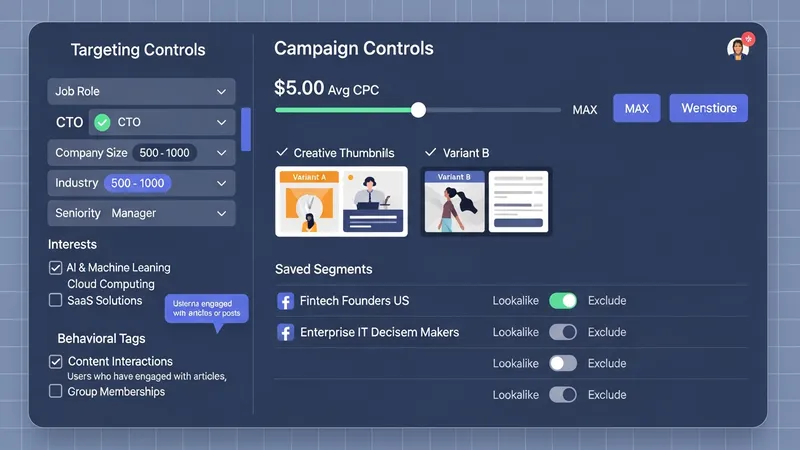
Targeting dimensions on professional networks may be organized into hierarchical layers that combine broad filters with narrower attributes. For example, a campaign might start by limiting delivery to employees at companies of a certain size, then refine to specific departments or seniority bands. Platforms may allow Boolean logic (AND/OR/NOT) when composing segments, which can reduce wasted impressions but also add complexity. When constructing segments, analysts often balance specificity against audience scale to maintain statistical validity for performance measurement and optimization.
Data sources used for segmentation usually mix profile data, platform interactions, and inferred interests. Profile data tends to be deterministic and stable (job title, company), while interaction data (content likes, group memberships, page follows) can indicate current interests or transient priorities. Some platforms augment these with third-party behavioral signals or conversion tracking pixels to connect on-platform exposure to off-platform actions. Practitioners often treat inferred signals as probabilistic inputs that may require validation through A/B testing or lift studies.
Segmentation workflows may include audience definition, seed-list import, lookalike expansion, and exclusion lists to avoid overlap across campaigns. Seed lists are often uploaded as hashed identifiers to preserve privacy and then matched to platform profiles for custom audience creation. Lookalike methods typically derive attributes from a seed population and expand reach to similar users while retaining core characteristics. Careful naming conventions and documentation help teams track which segments were used in which experiments and avoid redundant spending on overlapping audiences.
Measurement approaches on these platforms frequently emphasize engagement metrics (click-through rates, video completion) alongside conversion events that map to professional outcomes (lead form submissions, demo requests, content downloads). Attribution windows and event definitions can vary, so analysts often align platform reporting with internal analytics through shared conversion tags or server-side integrations. Because professional intent can be multi-step and prolonged, measurement plans commonly include time-based windows and cohort analyses rather than single-touch attributions.
In summary, advertising systems that operate within professional contexts provide layered targeting and segmentation tools that combine deterministic and inferred data. These systems may support seed lists, lookalike expansion, and campaign controls intended to align creative with specific professional cohorts. The next sections examine practical components and considerations in more detail.
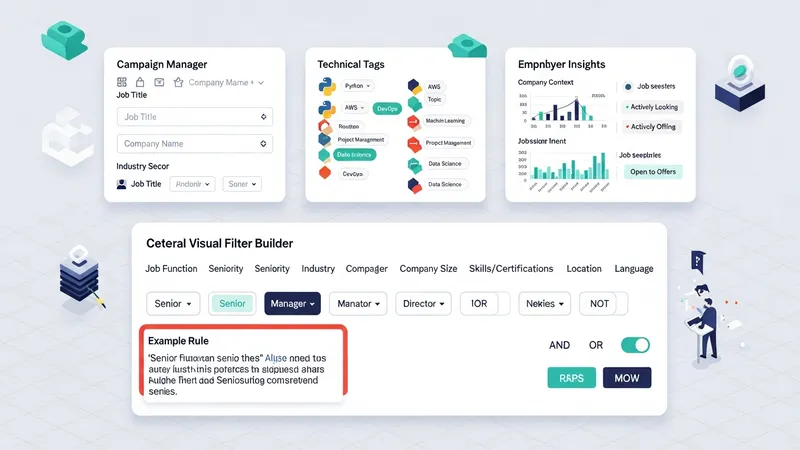
Professional-focused platforms usually expose a set of targeting dimensions that reflect occupational attributes. Common categories include job function, seniority level, industry classification, company size, and specific skills or certifications. These dimensions can often be combined with demographic filters such as location or language. When using examples from the list on Page 1, LinkedIn Campaign Manager tends to emphasize job and company metadata, Stack Overflow places weight on technical topics and tags, and Glassdoor may combine employer-related context with job-seeker intent. Practitioners typically select dimensions that most closely match campaign objectives while monitoring audience scale.
Many platforms allow Boolean combinations to refine segments—for instance, targeting senior product managers at mid-sized companies but excluding recruiters. Such combinations can improve relevance but may reduce available impression volume, so teams often iterate between broader and narrower sets. Seed-list workflows are common: an advertiser uploads a list of known contacts to create a matched audience and then uses lookalike or expansion tools to reach similar profiles. These mechanisms generally rely on hashed identifiers and platform matching to preserve basic privacy protections.
Contextual and interest signals may supplement explicit profile filters. On Stack Overflow, for example, topic tags and question categories can act as proxies for technical interests; on LinkedIn, group memberships and content interactions can suggest active professional priorities. These behavioral layers are often treated as probabilistic indicators, and some platforms expose confidence scores or audience sizing estimates to guide decisions. Using a mix of deterministic and behavioral attributes can help capture both stable role-based segments and more dynamic interest-based audiences.
Operational considerations include maintaining clear naming conventions for segments, tracking overlap between audiences, and documenting the origins of seed lists. Platforms usually report estimated audience size before launch, which can be useful for planning but may change as exclusions or additional filters are added. Teams often build experiment plans that compare a conservative deterministic audience against a broader behavioral expansion to observe performance trade-offs. Readers may find it useful to record segment definitions alongside creative variants to support later analysis.
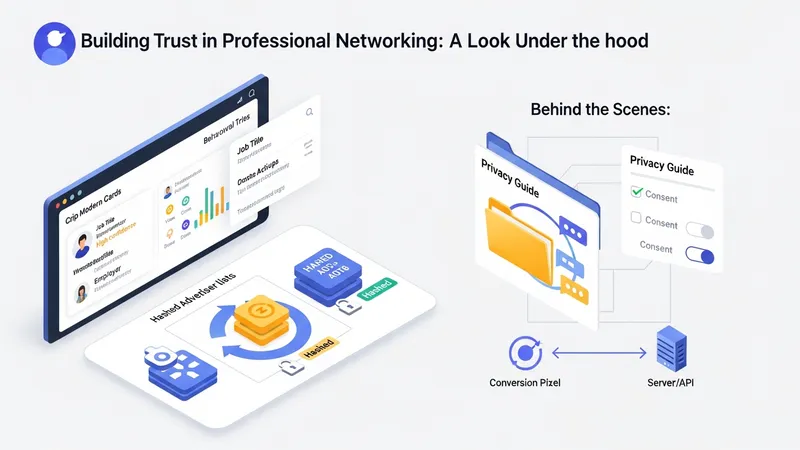
Professional network platforms typically use three primary data types for segmentation: first-party profile data, first-party behavioral data, and sometimes third-party or vendor-supplied enrichments. Profile fields (job title, employer) are usually self-reported and therefore considered higher-confidence. Interaction signals (content views, clicks, group activity) are logged by the platform and can indicate current interests. Some platforms also accept hashed lists from advertisers for custom audience matching. These different sources may be combined through platform tools or via external data management systems to construct composite segments.
Privacy and compliance considerations influence how audience data may be used. Many platforms provide documentation on permissible targeting attributes and on how seeded advertiser lists should be prepared (hashing, minimum list sizes). Where regulations require consent or restriction of certain attributes, platforms often adapt by limiting access to sensitive fields. Integrations such as conversion tracking pixels or server-side APIs enable measurement while introducing considerations about cross-site tracking and data retention; practitioners commonly review platform privacy guides and internal data governance policies before enabling these integrations.
Matching workflows for seeded audiences usually employ hashing and secure uploads to protect raw contact data. After matching, platforms often report only aggregate metrics or matched-size estimates to avoid exposing identifiable data. When using third-party enrichments, teams may verify vendor provenance and the freshness of attributes, since stale data can degrade segmentation accuracy. It is common to schedule periodic audience refreshes and to document data lineage so that attribution and compliance audits can reconcile observed outcomes with the inputs used to define audiences.
Technical integrations can affect the granularity of segmentation and reporting. Server-to-server conversion events typically provide more reliable attribution than client-side pixels in cases where ad blockers or privacy settings interfere with tracking. Platform APIs may also support automation of audience creation and campaign updates, which can be useful for large-scale segmentation strategies. However, automation requires careful error handling and naming conventions to avoid accidental audience overlap or incorrect exclusions.

Segmentation strategies on professional networks often start with hypothesis-driven cohort definitions tied to campaign goals. For awareness objectives, teams may target broader professional categories by industry and function; for lead-generation objectives, they may narrow to seniority and specific job titles. Using the Page 1 examples, LinkedIn is frequently used to reach decision-makers by title and company, Stack Overflow to reach technical implementers by topic area, and Glassdoor to reach active job seekers or employer-focused audiences. Teams commonly document hypotheses and expected outcomes before launching tests.
Workflows typically include an audience-definition phase, creative mapping, and a validation phase after initial delivery. During definition, segments are named and stored for reuse. Creative mapping involves aligning message variants to different segments so that language and offers are relevant to role and intent. Validation often involves a short test period to confirm that matches conform to expectations—checking demographic distributions and engagement patterns—and then adjusting either the segment or creative based on observed performance. This iterative cycle may repeat across multiple campaigns to refine segmentation accuracy.
Overlap management is an important operational detail. When multiple campaigns target similar cohorts, impressions can be duplicated and attribution can become noisy. Platforms may offer exclusion lists or audience hierarchy settings to prevent overlap; alternatively, teams may coordinate schedules and use mutually exclusive segment definitions. It is common to run control groups or holdout segments to estimate incremental impact, treating these as considerations rather than guarantees of outcome. Clear documentation of segment logic helps reduce unintended overlap and supports reproducible analysis.
Scaling segmentation often involves templating and parameterization so that a base segment can be adjusted for geography or sub-function without re-creating definitions from scratch. APIs and platform bulk-upload tools may accelerate this but require governance to avoid creating many near-duplicate segments. Analysts commonly track segment performance over time and retire or merge underperforming segments to reduce complexity. These practices aim to maintain a manageable set of well-understood cohorts that can be reliably compared in ongoing measurement.

Measurement plans for professional network campaigns usually define key performance indicators that align with professional outcomes, such as lead submissions, content downloads, or event registrations. Platforms often report engagement metrics alongside conversions, and teams map those platform metrics to internal definitions of success. Attribution windows can materially affect reported performance; therefore, analysts frequently test multiple windows and examine time-to-conversion distributions. Given that professional decision processes may be multi-stage, cohort analyses over extended periods are often used instead of single-click attribution.
Attribution methods can include last-click, multi-touch models, and incrementality tests. Incrementality testing—using randomized holdouts or geo-based controls—may help estimate causal impact of ad exposure, though it requires planning and sufficient sample size. Platforms sometimes provide built-in lift measurement tools or integrations with third-party measurement vendors. When using the Page 1 examples, clients might compare how conversion rates differ between a LinkedIn-defined seniority cohort and a Stack Overflow topic cohort to see where particular messages yield stronger responses.
Optimization is typically iterative: initial results inform which segments are scaled, refined, or paused. Common practices include reallocating budget toward segments that exceed predefined engagement thresholds, testing creative variations tied to specific roles, and adjusting bid strategies to align with conversion outcomes. Teams may also use automation rules cautiously—automated scaling can be helpful but should be monitored to avoid amplifying noisy signals. Documentation of decision rules and periodic audits of automated actions are often recommended as governance considerations rather than prescriptive mandates.
Reporting cadence and granularity should match campaign complexity and decision cycles. Daily metrics can surface immediate delivery issues, while weekly or monthly cohort reports tend to reveal trends and conversion latencies. Combining platform-reported metrics with internal CRM or analytics data can provide a fuller view of downstream outcomes, though reconciliation requires careful alignment of event definitions and time windows. These measurement practices may help teams iterate on segmentation and creative with clearer evidence about which professional cohorts are responding as expected.