
Business checking accounts designed for corporations may offer features distinct from those for individual or sole proprietor accounts, particularly regarding interest-earning capabilities. Accounts commonly categorized as high-yield business checking in the United States typically provide a higher interest rate on balances compared to standard business checking products. These accounts often function as a primary transaction account—used for incoming client payments, outgoing vendor payments, payroll, and daily cash management—while also providing businesses a way to earn interest on idle funds.
Understanding how such accounts operate involves examining account structures, typical interest rates, balance requirements, and related fee schedules. Corporations may find that certain account types allow them to combine liquidity and modest earnings on deposits, although these benefits can be contingent on minimum balance maintenance and the volume or type of transactions processed monthly. Access terms, deposit insurance coverage, and qualification requirements also differentiate these accounts from both personal and other business-oriented banking solutions.

Many high-yield business checking accounts available to U.S. corporations are governed by regulations such as FDIC insurance rules, transaction reporting policies, and anti-money laundering requirements. Account holders may need to provide corporate documents, federal tax identification numbers, and maintain compliance with relevant financial disclosure obligations. Such requirements help ensure account legitimacy and system integrity.
The interest rates accessible through these business checking accounts may fluctuate based on national rate environments. Unlike savings or money market accounts, high-yield business checking products often offer comparatively lower rates, but with the advantage of greater liquidity and unlimited transactional capability subject to internal bank policies. Some accounts may pay interest only above certain minimum daily balances.
Account fees can affect the net benefit gained from a high-yield business checking account. Service charges—such as per-transaction costs, monthly maintenance fees, or incidental fees for excess deposits or withdrawals—are important to consider when evaluating whether a high-yield structure supports overall financial management goals for a corporation.
Recent industry trends in the United States show a gradual increase in banks and fintech firms offering interest-bearing business checking options. Many incorporate digital banking services, cash management integrations, and real-time balance updates. However, the eligibility criteria, fee schedules, and included features can differ substantially between providers.
In summary, high-yield business checking accounts for corporations in the United States can blend operational convenience with basic interest earnings potential. The following sections examine practical components and considerations in more detail.
High-yield business checking accounts in the United States may feature a combination of transaction flexibility, digital banking services, and interest-earning structures. These accounts are typically set up to facilitate daily business operations—such as making payments, depositing checks, and managing recurring transactions—while providing interest on larger balances held within the account. Eligibility may depend on the legal entity status, business verification documents, and adherence to U.S. banking regulations.
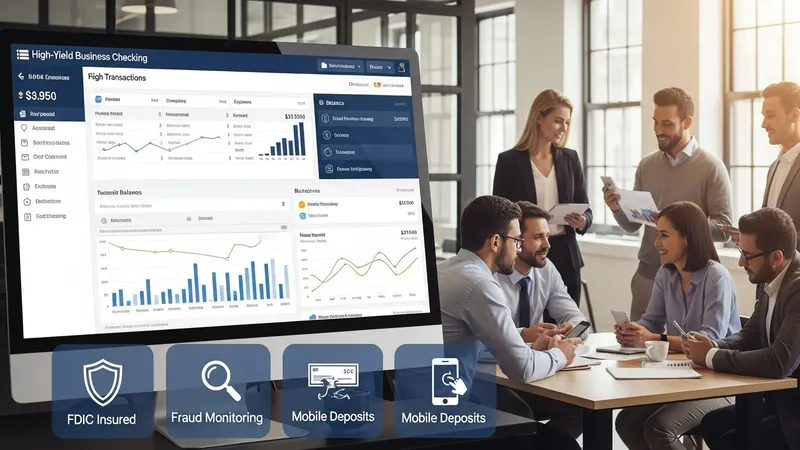
Account holders can generally expect a range of built-in safeguards and operational features. These often include FDIC insurance up to $250,000 per depositor and per institution, fraud monitoring tools, mobile check deposit, and access to both in-person and digital customer service. The digital access provided by many U.S. banks allows corporations to initiate wire transfers, automate bill payments, and integrate their accounts with accounting software for improved efficiency.
Policies regarding transaction limits, minimum required balances, and fee structures are set by individual financial institutions. Many high-yield business checking accounts waive monthly service fees if average daily or monthly balances meet a specified threshold. However, should balances fall below this amount, corporations may incur typical fees ranging from $10 to $20 per month, along with additional charges for excess transactions or certain deposit methods.
It is important to note that not all business checking accounts classified as “high-yield” offer interest rates that exceed other cash management alternatives. While the structure allows for interest earnings on operational funds, the rates are typically modest and variable, reflecting changes in Federal Reserve rates and overall market liquidity conditions. This dynamic underlines the need for corporations to periodically review account terms and associated disclosures.
The method by which interest is calculated on business checking account balances in the United States may vary between institutions. Typically, banks use either a daily balance or average daily balance calculation, applying an Annual Percentage Yield (APY) that can change over time. Interest is usually credited to the account monthly, and published rates are required to be disclosed in accordance with federal regulations.

Some high-yield business checking accounts apply tiered rate structures, where higher balances may qualify for incrementally higher interest rates. For instance, a corporate account with an average collected balance above $10,000 may earn a slightly higher APY than one with balances below that threshold, as specified in the bank’s account agreement and disclosures.
Certain providers may set minimum balance requirements to qualify for any interest accrual during a given period. If a corporation’s balance dips below this threshold, the account may not earn interest for that cycle, or the applicable rate may revert to zero. This stipulation is typically communicated in the fee and rate schedule associated with each product, in accordance with Truth in Savings Act requirements.
Interest credited on business checking accounts is generally taxable as ordinary income to the organization, and statements usually reflect both interest paid and cumulative balances. Corporations are expected to report these earnings for federal and state tax purposes. Banking platforms often provide digital statements and downloadable records for accounting and compliance reasons.
Fee structures associated with high-yield business checking accounts in the United States can influence the perceived benefit of such accounts for corporations. Typical fees include monthly maintenance charges, often ranging from $10 to $25 unless balance requirements are met; per-transaction fees for exceeding allotted free transactions; and charges for specific banking services such as wire transfers or issuing cashier’s checks.

Many financial institutions impose minimum balance policies to qualify either for fee waivers or for earning interest. These minimums may range from $1,000 to $15,000, depending on the size and nature of the business and the type of account selected. Maintaining these balances can be crucial for minimizing costs and maximizing the value received from an interest-bearing checking solution.
Transaction limits may also apply within high-yield business checking accounts. While federal regulations allow unlimited withdrawals and deposits, some institutions set a maximum number of complimentary transactions each month; for example, a checking account may include the first 200 transactions per month at no additional cost. Transactions beyond this limit typically incur a nominal fee, such as $0.30 to $0.50 per item, according to published schedules.
Managing these policies effectively requires ongoing monitoring of account activity and balances. Many U.S. corporations utilize digital banking alerts and cash management dashboards to track movements and plan for anticipated high-volume periods. Compliance with transaction policies helps businesses avoid unnecessary fees and maintain eligibility for interest accrual and account privileges.
Most U.S. high-yield business checking accounts now incorporate advanced digital features that enhance convenience and oversight for corporate account holders. Online banking portals, mobile apps, and automated cash management services provide real-time access to balances, transaction histories, and interest payment summaries. These digital solutions help corporations align everyday banking with broader financial workflows and risk management strategies.

Compliance remains a priority for U.S. financial institutions and their corporate clients. Know Your Customer (KYC) and Anti-Money Laundering (AML) procedures are embedded during the account opening process and may require updated documentation or periodic verification. Corporations must provide legal formation documents, Employer Identification Numbers (EIN), and, in some cases, operating agreements or board resolutions to satisfy regulatory standards.
Security technology within digital platforms often includes multi-factor authentication, activity monitoring, and fraud alerts designed to mitigate risks associated with electronic transactions. Account holders routinely receive educational updates about recognizing phishing attempts and maintaining secure login protocols, further supported by bank-initiated controls on suspicious activity or unusual transaction patterns.
As digital services continue to evolve, integration with third-party software—such as accounting solutions or cash flow analyzers—becomes increasingly common. These integrations can streamline reconciliation processes and improve decision-making based on near real-time financial data, while supporting compliance with U.S. accounting and reporting norms.