
Business incorporation services describe practical assistance for establishing a legally recognised company in Hong Kong. These services typically cover choosing a legal form, preparing required incorporation documents, submitting applications to the Companies Registry and the Inland Revenue Department for business registration, and arranging basic statutory records. The aim of such services is to help ensure that the entity meets regulatory requirements and that initial filings reflect the chosen governance and ownership structure.
Services in this area may be delivered by professional firms, licensed company secretaries, or experienced advisors who can clarify statutory obligations and administrative steps. Work commonly includes drafting the constitutive documents, completing incorporation forms, advising on director and company secretary roles, and explaining ongoing compliance such as annual returns and tax registration. The scope and format of assistance can vary depending on the legal form selected and the level of support required.

Comparing these examples, a private company limited by shares may often provide clearer separation between owners and the legal entity, which can affect liability and governance arrangements. Sole proprietorships and partnerships can be administratively simpler but may not provide the same separation of personal and business liabilities. A branch or representative presence may allow foreign firms to conduct business locally without a separate Hong Kong company, while subject to different filing requirements and disclosure obligations.
Document preparation commonly includes a company name check, completion of the relevant incorporation form (for example forms required by the Companies Registry), and drafting or adopting Articles of Association. Proofs of identity and address for directors or partners may be necessary for internal records and for bank account opening. A Hong Kong-registered company will typically appoint a company secretary and maintain statutory registers; these roles and records are described on government guidance pages and can affect filing timelines.
Fees and timelines can vary according to the method chosen and whether professional assistance is engaged. Government registration and filing fees in Hong Kong may commonly range from several hundred to a few thousand HK$ depending on the application type and whether paper or electronic submissions are used. Professional service fees, where used, can add to costs and typically reflect the scope of document preparation, consultations, and any additional administrative tasks.
Regulatory touchpoints after incorporation often include tax registration with the Inland Revenue Department, obtaining a Business Registration Certificate, and understanding the annual return and audit timetable under the Companies Ordinance. Compliance obligations such as maintaining accounting records, preparing audited financial statements (when required), and filing annual returns may typically follow set deadlines; timelines and exact requirements can vary with company type and size.
In summary, incorporation assistance in Hong Kong usually covers a sequence of choices and filings that set up a legal entity and initial compliance framework. The examples above illustrate different structural approaches and administrative implications that may apply. The next sections examine practical components and considerations in more detail.
Selecting an appropriate legal form is frequently the first substantive decision in the incorporation process. In Hong Kong, private companies limited by shares are commonly used for commercial trading and investment activities; they may often require distinct governance provisions such as share classes and director responsibilities. Sole proprietorships and partnerships can be administratively leaner but may expose owners to personal liability. Branches of foreign companies may retain upstream corporate relationships and require specific registration with the Companies Registry. Each option can influence accounting, tax reporting, and director or secretary requirements.
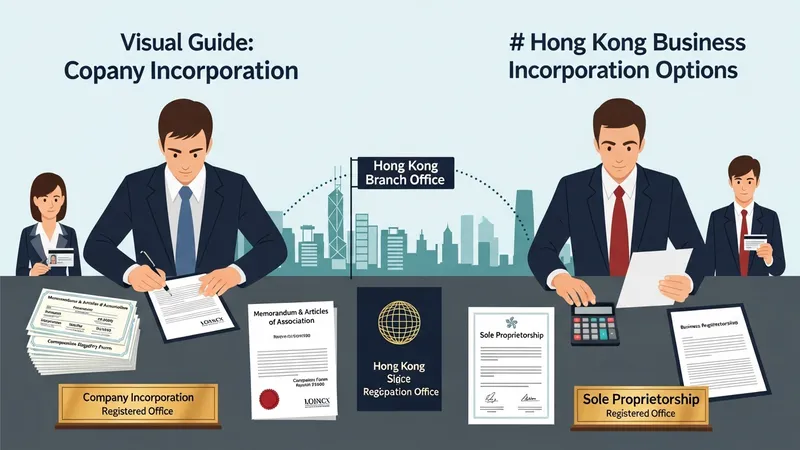
Practically, a private company limited by shares may typically need at least one director, a company secretary (an individual resident in Hong Kong or a Hong Kong-registered corporate secretary), and a registered office address in Hong Kong. The residency of directors and company secretary rules can affect suitability for a given operator. For sole proprietors or partnerships, the process often centres on obtaining a Business Registration Certificate from the Inland Revenue Department and maintaining simpler record-keeping, although tax filing obligations remain.
When considering a branch or representative office, business owners often weigh the degree of operational independence and disclosure obligations. A branch usually requires registration and may have to file financial information attributable to the Hong Kong operations, while a representative office is typically limited in commercial activities. These distinctions can affect continuity, liability, and the extent of statutory filings required by the Companies Registry and the Inland Revenue Department.
Selection criteria for the legal form often include liability containment, anticipated capital or investment structure, director and secretary logistics, and administrative capacity to meet statutory deadlines. Advisors and service providers in Hong Kong may outline these factors objectively so that entrepreneurs can assess how each form aligns with governance, tax, and administrative needs without implying a singular preferred choice.
Document preparation commonly begins with a company name search at the Companies Registry to confirm availability and compliance with naming rules. For a private company limited by shares, incorporation packets typically include the completed incorporation form, Articles of Association, details of directors and shareholders, and identification documents for key individuals where required. The Companies Registry website provides official forms and guidance, and submissions may often be made electronically or by paper, affecting processing times.
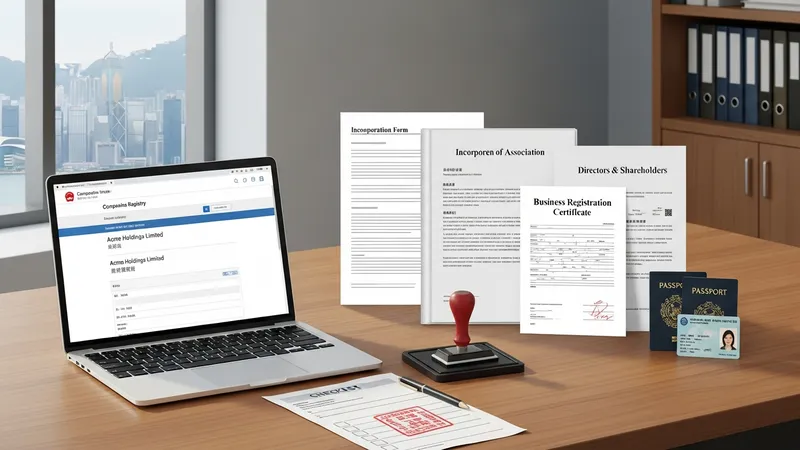
Business Registration with the Inland Revenue Department is generally a separate statutory step that runs alongside Companies Registry incorporation filings. The Business Registration Certificate details the nature of the business and tax registration particulars. Depending on the business activities, additional licences or permits from sectoral authorities (for example, food business licences or financial services licences) may be necessary; applicants typically consult the relevant department pages for licence-specific requirements.
Record-keeping documents that are typically created at incorporation include a company register of members, register of directors and secretaries, and minutes templates for initial resolutions. These internal records support statutory filings and are often required for bank account openings. Some incorporation services in Hong Kong may provide template documents and help with initial minutes, while leaving strategic governance choices to the company’s stakeholders.
Timing for filings and document acceptance may vary; electronic incorporation can often be faster than paper submission, and completeness of documentation tends to influence processing. Applicants frequently find that attention to detail—accurate names, consistent identity documentation, and clear address information—may reduce back-and-forth with registries and help meet expected filing timeframes.
Cost elements for incorporation in Hong Kong typically include government filing fees, business registration fees, and any professional service charges. Government fees for initial incorporation and business registration may commonly fall within a range of several hundred to a few thousand HK$, depending on the application type and whether expedited or electronic services are used. Professional fees for company secretarial work or document drafting may vary by provider and scope of service; where used, these fees typically reflect the complexity of the entity’s share structure and any bespoke documentation.

Timelines for incorporation can differ based on method and completeness of submission. Electronic filings may often be processed in one to a few working days if all documents are in order; paper submissions can typically take longer. Additional licensing requirements or sectoral approvals can extend the time before a company may commence regulated activities. Planning for potential variations in timing can help align administrative steps such as bank account applications or lease agreements.
When estimating total setup cost, stakeholders often consider not only initial fees but also ongoing administrative expenses such as annual return filing fees, audit and accounting costs (where applicable), and company secretary services. For smaller entities, ongoing costs may be modest; for larger or more complex structures, recurring compliance expenses can typically be higher and may influence the choice of legal form.
Practical considerations that may affect cost and timing include the need for translations of documents, notarisation or legalization for foreign-sourced documents, and identification verification for directors and shareholders. These administrative tasks can add time and expense, and those undertaking incorporation in Hong Kong often build contingencies into their timelines and budgets to account for such factors.
After incorporation, a company in Hong Kong commonly proceeds with post‑incorporation tasks such as opening a corporate bank account, registering for tax with the Inland Revenue Department, and obtaining the Business Registration Certificate. Companies typically must maintain statutory registers, prepare financial statements in accordance with the Companies Ordinance, and file annual returns with the Companies Registry. The company secretary often plays a central role in coordinating filings and ensuring deadlines are met.

Audit and accounting requirements depend on company size and activity; private companies may still be required to prepare audited financial statements for submission to shareholders and, where applicable, to regulators. Timelines for preparing annual financial statements and conducting audits may typically follow the financial year-end and statutory filing deadlines. Maintaining accurate accounting records from the start can ease these later obligations and support timely compliance.
Corporate governance duties such as convening annual general meetings, recording minutes of directors’ meetings, and handling changes in directors, shareholders, or registered office address are ongoing administrative responsibilities. Notifications to the Companies Registry and updates to statutory registers may be required within set timeframes; companies commonly monitor these requirements to avoid late filing penalties and to preserve good standing.
Finally, ongoing tax compliance with the Inland Revenue Department—filing profits tax returns and responding to enquiries—remains an important administrative area. Companies may also need to consider payroll tax, Mandatory Provident Fund obligations for employees, and any sector‑specific reporting. These post‑incorporation processes are typically procedural and form part of the regular administration of a Hong Kong entity.