
Organizations use specialized software to collect, standardize, and analyze greenhouse gas (GHG) information from operational systems, facilities, and supply chains. These platforms are designed to convert activity data—such as energy meters, fuel usage, and travel records—into emissions estimates using established emission factors and accounting rules. Typical functions include data ingestion from meters and enterprise resource planning (ERP) systems, mapping of emission sources, application of scope classifications, and storage of time-series records for auditing and trend analysis.
The software may support automated collection via APIs, manual uploads, and integration with utility bills or building management systems. It often implements protocols for emissions calculation, enables data validation workflows, and produces standardized outputs for internal dashboards and external reporting. Many enterprises in the United States use such tools to organize disparate data, maintain audit trails, and prepare the information that may be required by investors, regulators, or voluntary disclosure frameworks.
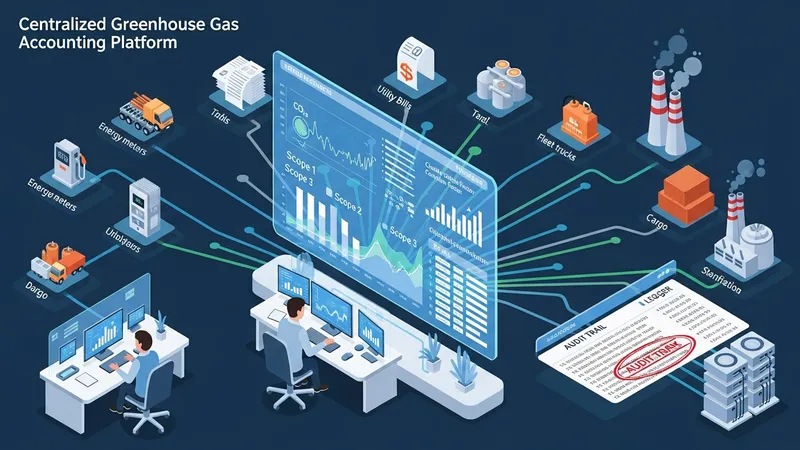
Enterprises may compare how different systems handle data sources, traceability, and calculation logic. Some platforms prioritize automated integration with utility and procurement systems, while others focus on manual data entry and document-based verification. Calculation logic commonly aligns with frameworks such as the Greenhouse Gas Protocol or EPA guidance; software may allow selection of region- or sector-specific emission factors. Data governance features—user access controls, audit logs, and versioning—often differ and can influence internal workflows for inventory reviews and external assurance.
Data quality and completeness are recurring technical challenges. Emissions estimates often rely on a mix of measured data, engineering estimates, and supplier-provided information; software tools may include features for uncertainty annotation, flags for missing data, and routines to apply default emission factors when primary data are unavailable. In the United States, organizations may need to reconcile state-level reporting requirements and voluntary frameworks. Effective adoption typically involves mapping data pipelines, defining responsibilities, and establishing periodic reconciliation processes to reduce discrepancies over time.
Integration with financial and operational systems can affect the pace and scope of implementation. Common integrations include energy management systems, procurement platforms, fleet telematics, and travel booking systems. Implementations in US enterprises often proceed in phases—starting with scope 1 and 2 emissions where metered energy and fuel data are available, then expanding to scope 3 categories that involve supply chain and upstream/downstream activities. Software that supports modular configuration may help organizations scale from pilot projects to enterprise-wide accounting.
Reporting outputs are shaped by intended uses such as internal performance monitoring, investor disclosures, or regulatory submissions. Outputs may include time-series dashboards, standardized emissions statements, and data exports compatible with reporting templates used by frameworks like CDP or the Greenhouse Gas Protocol. Third-party verification or assurance may be sought to increase credibility; software that documents source data and calculation steps typically eases that process. The next sections examine practical components and considerations in more detail.
Data sourcing is a fundamental component of enterprise emissions accounting. In the United States, common inputs include utility meter data, fuel purchase records, facility energy management systems, and fleet telematics. Software solutions may ingest these inputs via APIs, batch file uploads, or integrations with ERP and building management platforms. Integration design often determines how frequently inventories can be updated: near-real-time feeds for electricity meters can support monthly or daily tracking, while procurement systems may supply periodic purchase records that require mapping to emission factors.
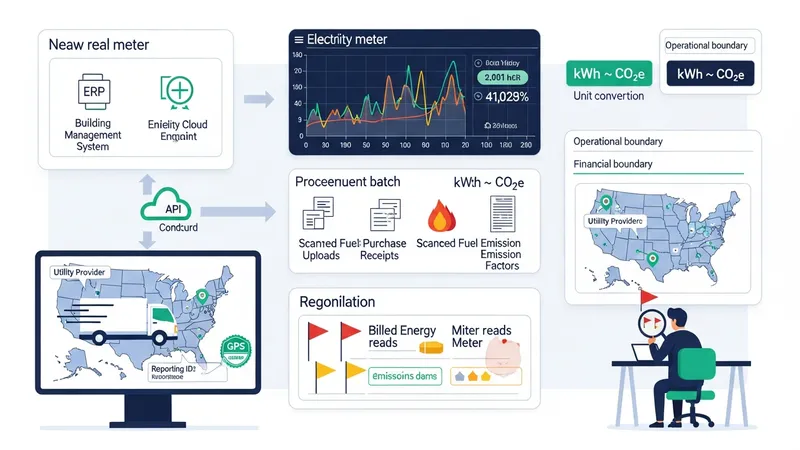
Mapping data to organizational boundaries and operational control models is an early integration task. Enterprises may choose control approaches aligned with established guidance from the EPA or the Greenhouse Gas Protocol; software often provides templates for operational and financial boundaries. Data reconciliation routines commonly flag inconsistencies between billed energy and meter reads, enabling analysts to investigate discrepancies. For multisite US companies, handling different utility providers, state-level reporting identifiers, and varying unit measures are typical integration considerations.
Supplier and scope 3 data collection is frequently more complex than facility-level inputs. United States organizations that track upstream emissions may rely on supplier questionnaires, lifecycle databases, or industry-standard emission factors; software may include modules to manage supplier responses or to import databases of emission factors relevant to US fuel mixes and manufacturing processes. Privacy and data-sharing constraints can affect the level of detail suppliers provide, so systems often accept aggregated inputs or proxy values with clear traceability.
Data governance and security are practical priorities when integrating across enterprise systems. Many US enterprises require role-based access, encryption in transit and at rest, and retention policies that align with corporate records management. Audit trails that capture who modified data, when, and why can support assurance activities. When planning integrations, organizations often document data lineage, expected update frequencies, and fallback procedures for when automated feeds fail.
Emissions calculation methods implemented in software generally reflect established protocols and region-specific emission factors. In the United States, tools often include factors for electricity grid mixes, state-level fuel factors, and EPA-recommended coefficients. Calculation modules typically allow users to select the appropriate scope classifications—scope 1 for direct emissions from owned sources, scope 2 for purchased energy, and scope 3 for indirect value-chain emissions. Software may provide configurable calculation engines to apply activity data to emission factors and aggregate results by facility, business unit, or product line.
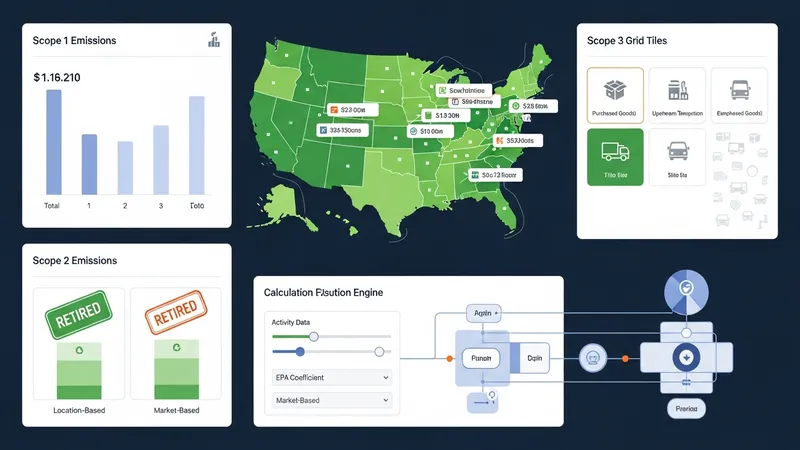
Scope 2 accounting commonly uses location-based and market-based methods; many US organizations track both to reflect physical grid emissions and contractual instruments such as renewable energy certificates (RECs). Software may support dual reporting and maintain documentation of supplier contracts or certificate retirements. Scope 3 categories—such as purchased goods, upstream transportation, and employee commuting—may require proxy methods or spend-based approaches when direct activity data are unavailable, and software often includes templates or default factors to facilitate preliminary estimates.
Software that supports scenario analysis and emission intensity metrics can aid internal decision-making. Enterprises in the United States sometimes calculate emissions per unit of production, per revenue dollar, or per full-time employee to compare performance across divisions. Calculation transparency—exposing the emission factors used, conversion steps, and any applied assumptions—is commonly important for internal review and external assurance. Platforms frequently provide exportable worksheets that document calculation logic for auditors.
Uncertainty management is another calculation-related consideration. Many tools allow users to annotate data with confidence levels or to run sensitivity analyses to show how changes in activity data or emission factors affect totals. For US enterprises that participate in voluntary reporting or that anticipate regulatory oversight, maintaining records of assumptions, data sources, and uncertainty estimates may support more robust disclosure and facilitate third-party validation.
Reporting functions in carbon accounting software often produce standardized outputs for voluntary disclosures and potential regulatory submissions. In the United States, enterprises may align outputs with guidance from the EPA, the Greenhouse Gas Protocol, or investor-focused frameworks such as CDP. Reports can include facility-level inventories, consolidated organizational totals, scope breakdowns, and trend analyses. Export formats typically include spreadsheets, PDF summaries, and machine-readable files that can be provided to stakeholders or used in regulatory filings where applicable.
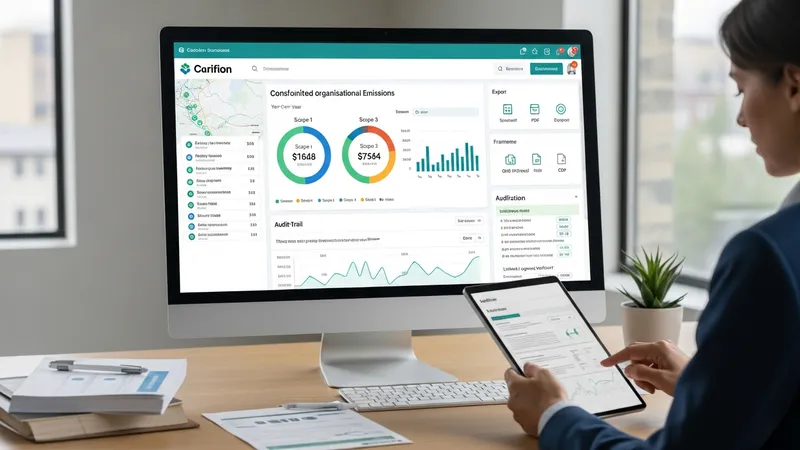
Verification and assurance features help prepare data for third-party review. Software may track and preserve source documents, capture approval workflows, and log calculation steps that verifiers require. In the US corporate context, assurance providers often request clear documentation of data provenance and control processes. Platforms that maintain version histories and standardized audit trails may streamline assurance engagements by showing how inputs were collected, normalized, and converted into emissions figures.
Compliance considerations in the United States can vary by sector and jurisdiction. Federal initiatives, such as proposed or evolving disclosure expectations, and state-level reporting requirements can influence reporting frequency and level of detail. Companies operating in multiple states may need to reconcile different regulatory timelines and data requests. Many organizations therefore design reporting outputs that can be filtered by jurisdiction and that include metadata to demonstrate alignment with specific reporting criteria.
Stakeholder reporting needs extend beyond compliance. Investors, customers, and lenders increasingly reference GHG disclosures when assessing organizational performance. Software that supports customizable dashboards and standardized export templates may help enterprises respond to diverse stakeholder requests. Maintaining consistent calculation methods and documented assumptions is typically important to preserve comparability across reporting periods and to manage stakeholder inquiries.
Cost drivers for carbon accounting software in US enterprises often include data integration complexity, number of reporting sites, and the extent of scope 3 coverage. Licensing models may vary—some providers offer subscription-based pricing that scales with user seats or data volume, while others provide modular pricing for specific features such as supplier engagement or assurance support. Implementation costs can include professional services for system configuration, ongoing data management, and staff time to validate and review inventories.
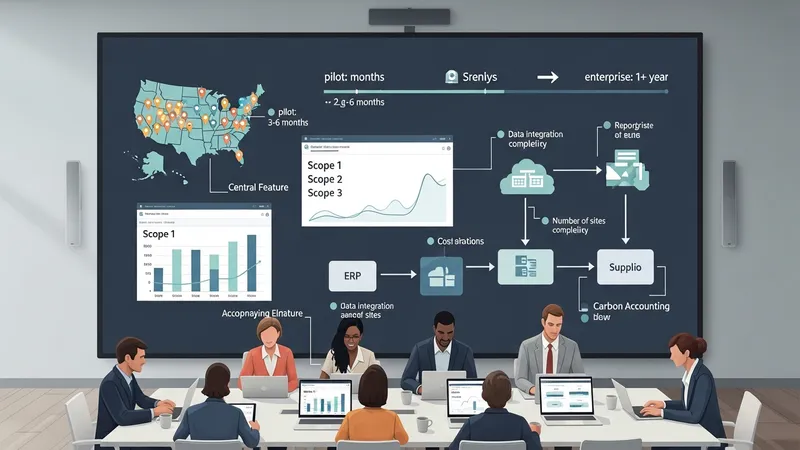
Implementation timelines commonly reflect organizational readiness and data availability. In the United States, pilots that focus on a subset of facilities or on scope 1 and 2 emissions can often be established within months, whereas enterprise-wide adoption including scope 3 categories may take a year or longer. Enterprises frequently allocate internal resources for project governance, data mapping, and change management to ensure consistent procedures and to build confidence in outputs among finance, operations, and sustainability teams.
Operational considerations include staffing, training, and ongoing maintenance. Software that automates routine ingestion and validation tasks can reduce manual effort, but companies often still invest in internal roles for data stewardship and quality control. Integrations with existing IT infrastructure may require coordination with security and compliance teams to ensure adherence to corporate policies, particularly for data confidentiality and retention. Vendor support models and SLAs can influence how organizations plan for troubleshooting and updates.
Evaluating return on investment is typically framed in terms of improved data quality, reduced time for reporting, and better-informed operational decisions rather than guaranteed financial outcomes. For many US enterprises, clearer emissions data can inform energy efficiency measures, procurement choices, and capital planning, which may contribute to operational cost management over time. Careful scoping of initial projects and phased rollouts often helps organizations manage implementation cost and complexity while building internal capabilities for ongoing accounting and reporting.