
The use of light-emitting diode (LED) technology in commercial settings centers on fixtures and systems designed to meet workspace needs for visibility, safety, and atmosphere. Commercial LED solutions combine semiconductor light sources, electrical drivers, housing, and optical components to produce controlled output measured in lumens. Key performance attributes include correlated color temperature (CCT), color rendering index (CRI), luminous efficacy (lumens per watt), and expected operational life measured in hours. In business environments these systems are selected to align with tasks, ceiling heights, mounting types, and interior finishes rather than residential aesthetics.
Commercial lighting systems also integrate controls and compatibility features such as dimming, occupancy sensing, and networked lighting management. Installation factors typically cover fixture mounting, thermal management, driver access, and compliance with local electrical codes. Maintenance considerations often focus on ease of light-source replacement (when applicable), driver lifespan, and service access. Safety and regulatory compliance can involve standards for photobiological safety, electromagnetic compatibility, and emergency lighting performance in applicable jurisdictions.
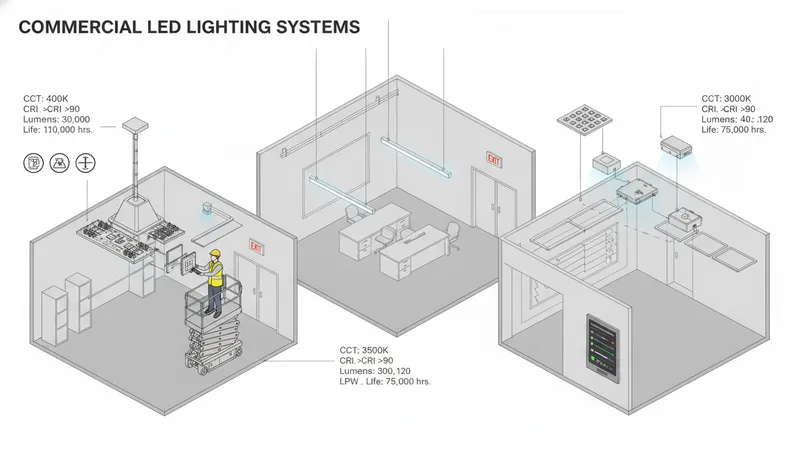
Performance metrics such as lumen output, luminous efficacy, and CRI provide a common basis for comparing fixture options. Lumen output measures total visible light, while efficacy relates output to electrical input and therefore can indicate relative energy consumption. CRI describes how accurately a light source renders colors compared with a reference; many commercial settings may prefer CRI values that support accurate color recognition without implying a single universal target. CCT often ranges from cooler tones for task-focused areas to warmer tones for customer-facing or hospitality-adjacent zones.
Fixture selection is also shaped by mounting geometry and space constraints. Recessed troffers may be chosen for existing suspended ceilings to achieve uniform ambient illumination, while high-bay fixtures with narrow or wide beam optics may be preferred at greater ceiling heights to control glare and aisle illumination in warehousing. Linear systems can be continuous-run or modular; they often permit targeted accenting of displays. Each type may integrate optic choices such as diffusers, lenses, or reflectors to shape light distribution for the intended application.
Controls and system integration are increasingly central to commercial LED deployments. Dimming protocols (e.g., 0–10V, DALI) and networked control platforms may be specified to enable daylight harvesting, occupancy-based reduction, or scheduled dimming. Such features can influence system complexity, initial configuration time, and interoperability with building management systems. When controls are present, designers often plan for commissioning and occasional recalibration to maintain expected performance over the system life.
Maintenance planning typically addresses driver replacement, thermal stress mitigation, and fixture cleaning. LEDs themselves may exhibit long rated lifespans, but ancillary components such as drivers, connectors, or lenses can require periodic attention. Access for service, clear documentation, and a maintenance schedule that considers operating hours and environmental factors (dust, humidity, heat) may help maintain consistent photometric performance. For larger installations, asset tagging and facility records often aid lifecycle tracking and phased upgrades.
In summary, commercial LED systems encompass a range of fixture types, performance metrics, and integration options suited to different business spaces. Selection involves balancing light quality, distribution, energy use, installation constraints, and serviceability. The next sections examine practical components and considerations in more detail.
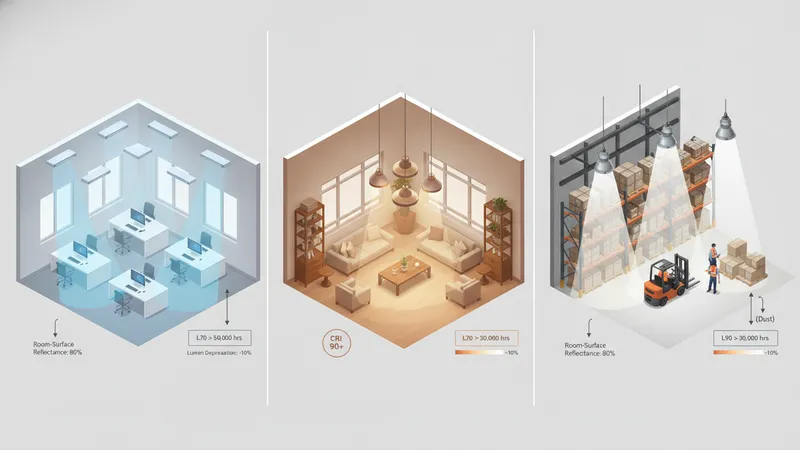
Lumen levels and distribution patterns are fundamental when matching luminaires to space tasks. Offices often aim for uniform ambient levels that support visual comfort for computer and paperwork tasks, while warehouses require higher concentrated lumen densities for aisles and picking areas. Designers typically consider maintained illuminance (accounting for fixture depreciation and room surface reflectances) rather than initial lumens alone. Light loss factors such as dirt accumulation and lumen depreciation (L70, L90 metrics) may be used to estimate long-term delivered light levels and schedule maintenance or replacement cycles.
Color temperature choices relate to perceived brightness and occupant preference. Cooler CCTs (e.g., around 4000–5000K) may be used for task-oriented spaces where visual acuity is a priority, whereas warmer CCTs (e.g., 2700–3500K) may be applied in customer-facing areas to create a softer ambiance. These ranges are illustrative; project-specific considerations such as branding, circadian impacts, and existing lighting should be evaluated. Mixing CCTs in a single space can be done deliberately but typically requires careful coordination to avoid visual inconsistency.
Color rendering (CRI and spectral considerations) may affect product presentation in retail and color-critical tasks in industrial processes. Many commercial specifications reference CRI values as part of quality criteria, recognizing that higher CRI does not always equate to a single correct choice for every application. Alternative metrics like TM-30 may provide additional insight into color performance. Photobiological safety classifications and blue-light content are other spectral attributes that can be considered for occupant comfort and regulatory compliance where relevant.
When documenting lighting requirements, professionals often present target illuminances, acceptable CCT ranges, and minimum color-rendering metrics alongside layout diagrams. These specifications allow manufacturers and installers to select compatible fixtures and control strategies. Such documentation can also support life-cycle cost comparisons by combining expected energy use, maintenance intervals, and depreciation assumptions to inform planning without asserting a single optimal solution.
Fixture families introduced earlier—recessed panels, high-bays, and linear systems—each have typical installation patterns and mechanical requirements. Recessed ceiling modules usually require a compatible grid and may include plenum-rated components when installed above drop ceilings. High-bay fixtures often need suspension points, appropriate driver access, and thermal clearance to control case temperatures. Linear systems may be surface-mounted, suspended, or recessed and often require careful alignment for continuous runs. Installation planning typically accounts for mounting hardware, wiring paths, and accessibility for future maintenance.
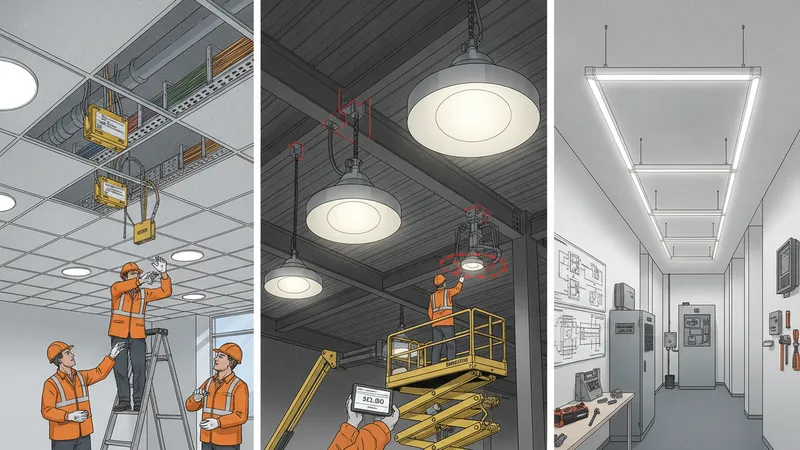
Electrical installation considerations include driver location, conduit runs, junction box placement, and compatibility with dimming or control wiring. Many commercial projects deliberate on centralized driver locations or remote drivers to improve serviceability or thermal performance. Emergency lighting integration, where required by local codes, may mandate separate circuits, battery packs, or central inverters. Installers commonly verify lumen output and operation under intended control schemes during commissioning to ensure the installed system meets design intent.
Thermal management and fixture durability are practical concerns in many business spaces. Heat-sinking design can influence driver lifespan and lumen maintenance; fixtures intended for high ambient temperatures or enclosed housings are often specified accordingly. In humid, dusty, or corrosive environments, IP ratings and material choices (e.g., powder-coated steel, polycarbonate lenses) can affect longevity. For exterior or canopy applications, weather sealing and gasketed enclosures are typical requirements to maintain performance.
Coordination with other trades and building systems is common during installation. Ceiling coordination may affect HVAC diffusers or sprinkler layouts, while structural attachments could require engineered anchors. Lighting placement can interact with acoustic treatments and signage. Early-stage layout reviews and pre-installation mock-ups may help reduce on-site changes and support smoother commissioning without implying a single mandatory process for all projects.
Energy use is often quantified in terms of connected load (watts) and delivered illuminance per watt. Luminous efficacy (lumens per watt) provides a baseline for comparing sources but actual energy use depends on controls, operating hours, and end-use behavior. Daylight-responsive dimming, scheduling, and occupancy sensing can reduce energy consumption in many commercial settings by lowering output when full illumination is unnecessary. Savings estimates vary with building type and occupancy patterns; designers commonly model expected operating hours to project potential reductions rather than asserting fixed savings amounts.
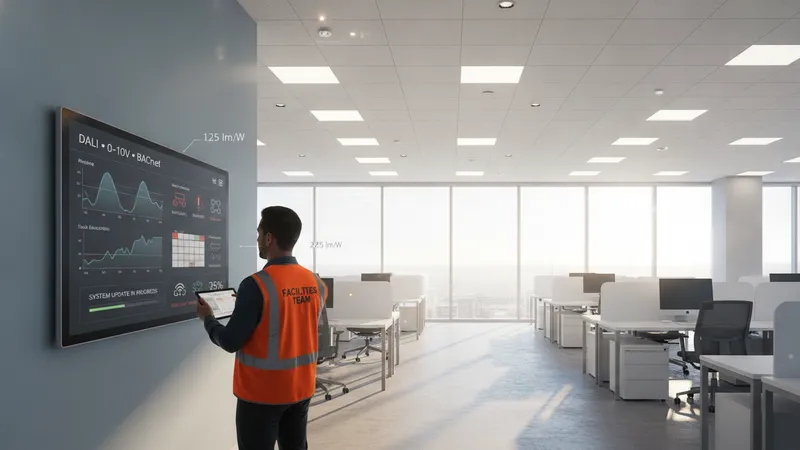
Control interoperability is an important operational consideration. Systems using standard protocols (e.g., 0–10V, DALI, or wireless standards) may allow integration with building management systems and remote monitoring. Centralized lighting management can support analytics such as runtime tracking and fault detection, which may assist maintenance planning. However, increased connectivity can add configuration complexity and may require periodic firmware or network maintenance as part of facility operations.
Operational factors include scheduled maintenance, replacement policies, and spare-parts strategies. Facilities often plan for driver and sensor replacement intervals and may stock commonly used components. Lifecycle planning might also consider phased retrofits, where initial capital constraints result in staged upgrades. Such approaches can spread installation impact over time while allowing incremental improvements in light quality and control sophistication.
When estimating total cost of ownership, practitioners typically account for energy consumption under expected usage profiles, routine maintenance labor, replacement parts, and potential downtime during servicing. Modeling tools and lighting calculators are frequently used to compare scenarios, and sensitivity analyses may be applied to understand how variations in operating hours or component lifespans affect projected outcomes. These analyses are intended as planning aids rather than absolute forecasts.
Compliance with safety and performance standards is part of commercial lighting specification. Certifications and listings (such as national electrical standards or third-party safety marks, where applicable in a jurisdiction) often address electrical safety, fire risk, and photobiological classifications. Specifiers may reference applicable standards for ingress protection, thermal performance, and electromagnetic compatibility. Emergency egress lighting and backup power requirements are typically governed by local building and life-safety codes and are incorporated into fixture selection where emergency performance is required.
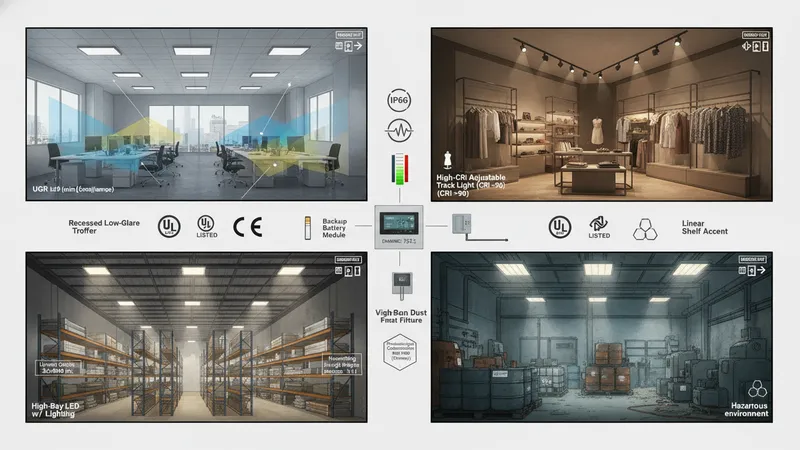
Applications vary by business type: offices commonly emphasize visual comfort and low-glare distributions; retail spaces focus on color fidelity and flexible accenting; warehouses prioritize high lumen density and aisle uniformity; industrial facilities may require ruggedized fixtures and ingress protection. In each case, designers assess the interplay of task requirements, fixtures introduced earlier (troffers, high-bays, linear systems), and control strategies. Case-specific environmental factors such as dust, chemicals, or vibration influence the selection of materials and mounting methods.
Documentation and testing play roles in ensuring compliance and performance. Photometric data (IES files), dimming behavior under specified control protocols, and warranty terms for electrical components are typically reviewed before procurement. For large projects, mock-ups or sample installations may be tested on-site to confirm both aesthetic and functional outcomes under real operating conditions. Such validation helps align expectations without implying a guaranteed result for every installation.
Overall, deploying LED systems in commercial settings involves assessing performance metrics, fixture mechanics, operational practices, and safety requirements in context. Stakeholders often balance competing priorities—visual needs, energy use, durability, and maintenance access—using project-specific data and documentation. Readers may find that systematic evaluation of these elements supports clearer planning and coordination across design, installation, and facilities management teams.