
Container housing refers to residential structures that repurpose steel shipping containers into living spaces. In the United States this approach is discussed as a modular, adaptive construction method that may use single containers, multiple connected units, or stackable arrangements to form compact dwellings. Containers provide a defined structural shell that can be modified for doors, windows, insulation, and services, and builders often pair them with conventional building practices to meet local codes and occupant needs.
In U.S. urban contexts, container housing is considered alongside other modular techniques as a potential component of infill development, accessory dwelling units (ADUs), and temporary or transitional housing. Design choices typically address structural reinforcement, thermal performance, moisture control, and site logistics such as delivery and crane access. Discussion in planning and design circles often frames container housing as one set of modular options rather than a single solution.
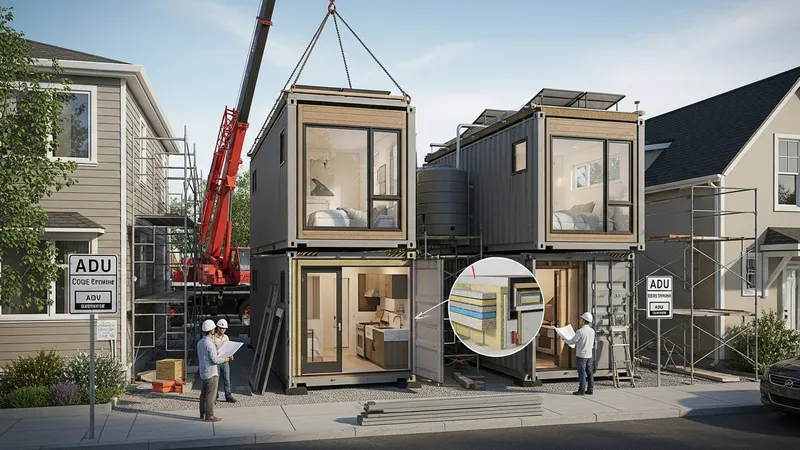
Container dimensions in the United States are commonly 20-foot and 40-foot lengths with standard widths, which influences layout and transport logistics. Converting a container may often involve cutting openings for doors and windows, reinforcing corners or cut areas, and adding a thermal envelope. Local permitting processes typically assess whether a container-based structure will be classified as a permanent dwelling, a manufactured unit, or a non-permanent structure—an outcome that can affect foundation requirements, inspections, and utility connections.
Thermal and moisture control are frequent technical concerns for container housing. Steel conducts heat and cold, so designers often add continuous insulation, thermal breaks, or interior framing to meet energy-code targets. Corrosion protection and proper ventilation are commonly noted as necessary to limit condensation and preserve structural integrity. In the United States, applicable energy and building codes are frequently enforced at the state or local level and may reference standards from the International Code Council (ICC) or state codes.
Site and logistical considerations commonly shape feasibility in U.S. cities. Transporting a 40-foot container typically requires truck access and may need permits for oversize loads; on-site crane lifts or forklifts can be necessary for placement. Foundation choices—pier, slab, or continuous—can influence whether a unit is treated as permanent real property. Utilities, stormwater management, and access for emergency services are additional municipal concerns that planners and permitting officials often review.
Affordability and lifecycle factors are discussed as contextual considerations rather than guarantees. Material reuse can reduce some embodied-materials impacts, but conversion and finishing costs, site work, and compliance with codes can add expense. Lifecycle performance with regard to energy use, maintenance, and adaptability to changing needs is often evaluated alongside conventional modular and stick-built alternatives when municipalities and developers consider policy or pilot projects.
In summary, container housing in the United States represents a modular construction approach that may be applied to microhomes, multi-container assemblies, and ADUs. Technical issues such as insulation, corrosion protection, and structural modifications commonly inform design and permitting. Regulatory classification and site logistics often determine feasibility in specific U.S. jurisdictions. The next sections examine practical components and considerations in more detail.
Container housing configurations in U.S. practice typically vary by unit count and assembly method. Single-container microhomes often use one 20-foot or 40-foot container arranged for compact living, while multi-container assemblies join two or more units to expand floor area and create multiple rooms. Stackable systems may add vertical density but usually require additional structural engineering. Configurations also differ by use: standalone dwellings, accessory dwelling units (ADUs) on existing lots, or clustered modules in infill developments. Choice of configuration often responds to lot size, zoning, and access constraints in U.S. cities.
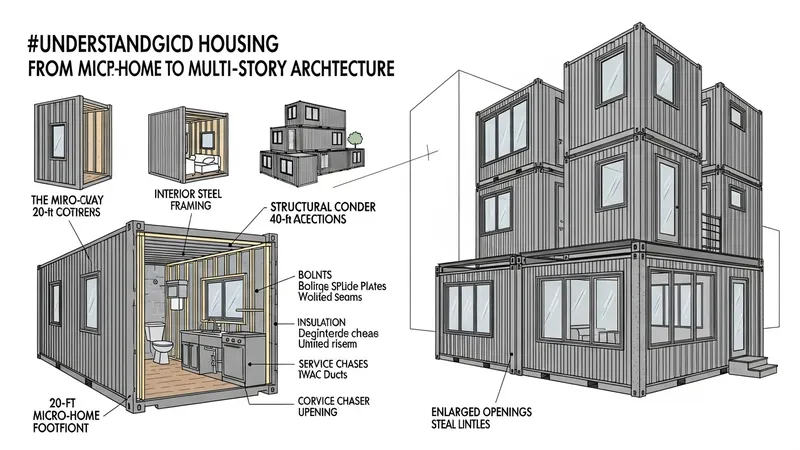
Each configuration commonly requires different structural and envelope strategies. Single-container units may rely on interior framing for insulation and services, whereas multi-container assemblies often need welded or bolted connections and additional support at cut openings. Stack stacks may require moment frames or additional corner-post reinforcement. Designers frequently document these modifications to satisfy local building departments and, when applicable, referenced ICC code sections for structural adequacy.
Typical sizing and layout practices in the United States reflect container dimensions: a 40-foot container may yield a basic long-plan studio, while two side-by-side containers can create a wider living space. Interior planning often emphasizes efficient circulation and multi-functional zones to make the most of limited floor area. Where ADUs are proposed under state ADU reforms or local ordinances, configuration choices must align with setback, height, and parking rules that differ across municipalities.
Practical considerations for configuration selection often include transport and site-access limitations. Moving a 40-foot container on U.S. roads may require permitting and escort services depending on local rules; on-site handling can involve local crane operators or heavy-equipment contractors. These logistics commonly affect the sequencing and cost of a project and are notable items in feasibility assessments at the municipal or developer level.
Regulatory classification often determines how a container dwelling is permitted in the United States. Local building departments may classify converted containers as stick-built housing if permanently affixed to a foundation, or as non-permanent structures if placed on temporary supports. Some jurisdictions apply manufactured housing rules if a unit meets certain transportability and factory-built criteria. Designers and owners commonly consult the International Building Code (IBC) or local amendments and may coordinate with planning staff to clarify classification before construction.
Zoning and land-use rules in U.S. municipalities typically affect siting and allowable uses of container units. ADU regulations in many states have been updated in recent years to facilitate secondary units; however, lot coverage, setbacks, and height limits still vary by city and county. Municipalities often require building permits, electrical and plumbing inspections, and zoning clearance. Early engagement with local planning and building departments is frequently recommended as a planning consideration rather than a guarantee of approval.
Energy, fire, and safety codes are commonly applied to conversions. Compliance with energy codes may require calculations for insulation, glazing, and HVAC sizing to meet state or local energy standards; the U.S. Department of Energy provides guidance on building performance approaches. Fire-resistance and egress requirements sometimes necessitate additional design work where container partitions or openings are modified. These code-related items are typically evaluated during plan review and inspection phases.
Permitting timelines and documentation practices differ across U.S. jurisdictions and can affect project scheduling. Some municipalities have pilot programs or specific permitting pathways for modular and prefabricated construction; others treat container conversions like any new structure. Applicants often prepare engineered plans, structural calculations for openings and connections, and details for foundations and utilities to support permit approval processes in their locality.
Common construction methods for container housing in U.S. practice include cutting and reinforcing openings, attaching interior framing for insulation and services, and adding external cladding or roof assemblies to control thermal performance. Structural reinforcement may involve steel plates or additional framing where large openings are made. Waterproofing and corrosion mitigation are often addressed with coatings and careful detailing at seams. Builders and designers typically document these measures in construction drawings to meet building code and inspection requirements.
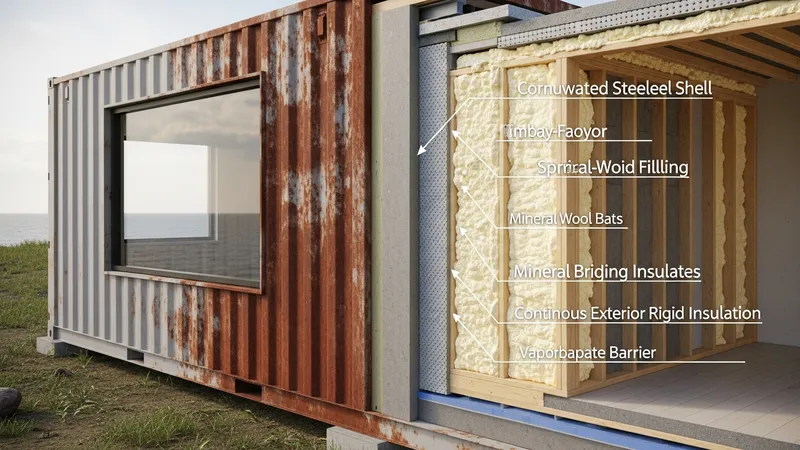
Material choices can influence durability and indoor comfort. Containers are made from weathering steel (often corten) that may require surface treatment when repurposed for housing; poorly treated surfaces can corrode in coastal or humid environments. Insulation strategies may include spray foam, mineral wool, or continuous exterior insulation to reduce thermal bridging. Ventilation, moisture control, and vapor management are commonly integrated to limit condensation and indoor air-quality risks.
Sustainability aspects of container housing are often framed in terms of material reuse, reduced on-site waste, and potential for factory-controlled fabrication. Reuse of shipping containers can reduce embodied steel demand relative to new framing in some scenarios, but conversion energy and additional materials for insulation and finishes also contribute to lifecycle impacts. Energy-efficiency measures such as high-performance insulation, LED lighting, and heat-pump HVAC systems are frequently considered to improve operational performance in U.S. climates.
Integration with renewable systems and resilient design measures is often discussed in U.S. planning contexts. Solar photovoltaic arrays, battery storage, and rainwater management systems may be paired with container units to support off-grid or low-impact operation where permitted. Designers typically evaluate site-specific constraints, local incentives, and grid interconnection rules when considering such systems within the regulatory frameworks of U.S. utilities and jurisdictions.
Cost drivers for container housing in the United States commonly include purchase or acquisition of the container shell, structural modifications, insulation and finishes, site work, foundation, utility hookups, and permit fees. Basic conversion of a single container may often involve modest shell costs but additional interior finish and systems work frequently raise total project budgets. Typical conversion cost ranges may vary widely by location and scope and are commonly influenced by local labor rates and regulatory requirements.
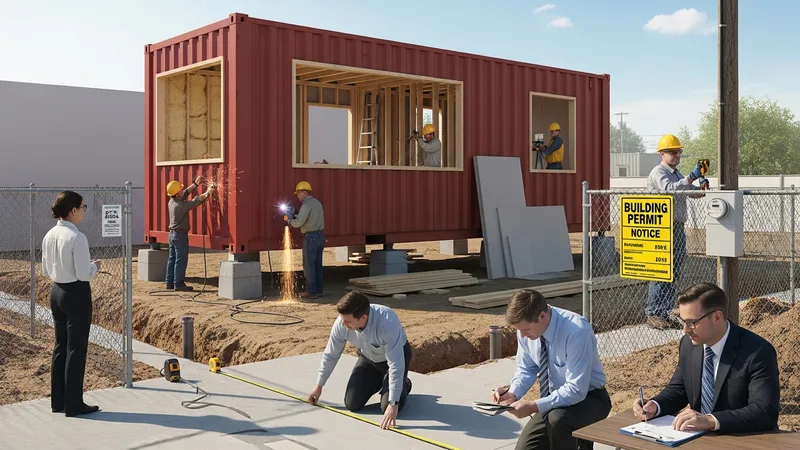
Financing and appraisal considerations may differ from conventional housing in U.S. markets. Some lenders and appraisers treat container-based dwellings as personal property if not permanently affixed, which can affect loan products and terms. Others evaluate permanence of foundation and utility connections as indicators of real property status. Prospective owners and developers often consult local financing professionals, community development entities, or lenders familiar with modular and manufactured housing to understand available pathways.
From an urban planning perspective, container housing is sometimes noted for its potential role in infill and accessory housing strategies in U.S. cities. Municipal planners often assess how modular units could contribute to increased density, diverse housing types, or temporary housing solutions while also considering infrastructure capacity, neighborhood character, and long-term maintenance. Pilot projects and case studies in some U.S. jurisdictions have informed local guidance and zoning adjustments.
Policy and programmatic responses in the United States may influence the feasibility of container housing at scale. Local incentives, code adaptations for factory-built and modular units, or expedited permitting for certain housing types can alter project economics. Planners and stakeholders commonly weigh trade-offs among speed of deployment, durability, energy performance, and integration with existing neighborhoods when considering container housing as part of broader housing strategies.