
Construction-focused software delivered as industry-specific cloud services organizes project data, communication, and administrative workflows in ways tailored to building and civil projects. These platforms concentrate on tasks such as schedule tracking, cost budgeting, document control, change management, and field reporting, aligning toolsets to typical construction roles (project managers, superintendents, estimators, and owners). The software often includes mobile access for field personnel, structured repositories for drawings and submittals, and workflow engines for approvals that reflect construction project lifecycles rather than generic business processes.
Deployments for construction tend to emphasize integrations with accounting systems, plan viewers, and on-site capture tools, enabling teams to maintain a shared record of decisions and deliverables. Industry-specific features commonly include RFI (request for information) tracking, punchlist management, and change-order workflows. In United States practice, these platforms may also support documentation needed for contract compliance, permitting, and lien or retention processes, while providing role-based access controls to separate field and office responsibilities.
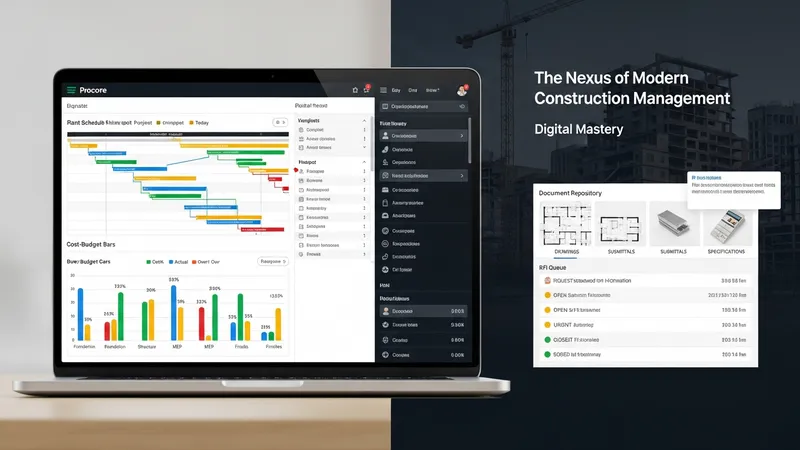
Many construction organizations compare industry-specific clouds with generic project software by looking at workflow fit and data structures. Construction platforms typically provide preconfigured entities such as drawings, RFIs, and change orders that may reduce configuration time relative to general-purpose tools. They can also impose discipline on recordkeeping by attaching metadata (drawing revisions, dates, responsible parties) to each document. That said, adoption patterns vary across contractors in the United States: larger firms may prefer deeper integrations with enterprise finance systems, while smaller contractors may prioritize mobile field entry and simplified cost tracking.
Integration capabilities often determine how effectively a construction platform supports delivery. Common integrations include accounting systems (for payroll and lien waivers), subcontractor portals (for bid and payment workflows), and model viewers (for geometric coordination). File formats such as DWG and IFC are frequently exchanged between design and construction tools in U.S. projects that use building information modeling (BIM). Interoperability considerations may influence whether a firm centralizes data in a single platform or uses a hub-and-spoke approach where a core system exchanges data with specialised tools.
Field adoption and user experience are practical considerations that can affect project outcomes. Mobile forms, offline capabilities for areas with limited connectivity, and simplified interfaces for foremen or inspectors may increase the consistency of data captured on site. Usage patterns in the United States often reflect workforce composition and project scale: residential remodelers may adopt different feature sets than heavy-civil contractors. Training and governance are commonly needed so that data entered in the field aligns with office workflows for estimating, billing, and compliance.
Security, access control, and document retention also shape how these platforms support delivery. Construction records can be relevant for contract disputes, permitting, and payment processes; consequently, U.S. contractors may require audit trails and exportable archives. Role-based permissions and single sign-on options may be used to limit exposure of sensitive financial or personnel data. Vendors and project teams often negotiate data ownership clauses and export formats during procurement to ensure that historical project records remain accessible after contract transitions.
Overall, these industry-focused cloud tools aim to align digital workflows with construction practice rather than general office workflows. They may streamline coordination between design and field teams, clarify document revision status, and centralize communication tied to project deliverables. The next sections examine practical components and considerations in more detail.
Construction-oriented SaaS platforms are typically organized into modules that map to core project activities. Common module categories include project controls (schedules, milestones), document management (drawings, submittals, RFIs), financials (estimates, budgets, change orders), and field operations (inspections, daily reports, safety observations). In United States projects, financial modules frequently need to support lien waiver tracking and certified payroll where applicable. Teams often evaluate which combination of modules covers their workflows rather than adopting every available feature.
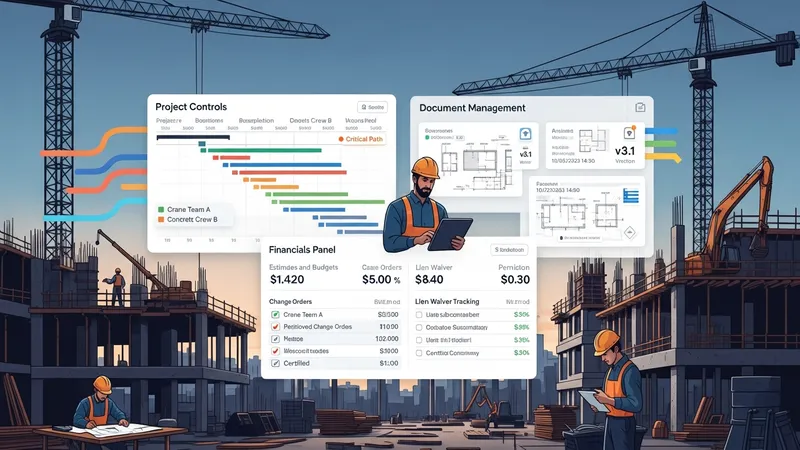
Project controls modules may include Gantt scheduling, resource allocation, and baseline comparisons that help teams understand schedule variance. Document management modules commonly provide versioning and permissions to ensure the correct drawing set is available to field crews. Financial modules in the United States may connect to typical accounting packages, enabling cost-to-complete reporting. Field operations modules often emphasize mobile capture and photo documentation, enabling faster assembly of record packages for permits and inspections.
Module scope can affect implementation complexity and total cost of ownership. Comprehensive suites may reduce the need for point solutions but can require more configuration and training; conversely, focused tools that specialize in a single area may integrate into existing stacks with less disruption. Decision factors often include project size, subcontractor ecosystem, typical contract types used in U.S. markets, and whether the organization manages multi-project portfolios or primarily single-project workstreams.
When specifying modules, teams commonly document required workflows and handoffs to identify missing capabilities. For example, a construction manager may map the sequence from RFI issuance to change-order billing to ensure financial controls are present. Considerations such as offline field access, audit logs for contractual records, and support for common U.S. file formats (e.g., PDF, DWG) are often included in module requirement lists to align vendor offerings with operational needs.
Integration strategies influence how project data moves between bidding, design, construction, and accounting systems. Common integrations in United States environments include links to QuickBooks Online or Sage construction accounting systems, model viewers such as those in Autodesk tools, and payroll or subcontractor payment processors. APIs and middleware may be used to synchronize cost codes, job numbers, and vendor records so that financial reporting across systems can be reconciled without extensive manual entry.
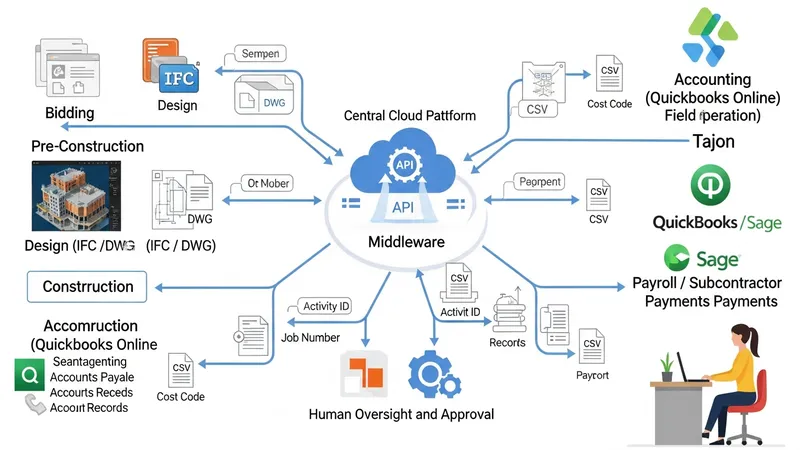
Data models differ across platforms, so mapping fields (cost codes, activity IDs, drawing numbers) is often required to preserve meaning during exchanges. File interoperability often relies on standards such as IFC for models and DWG for drawings, which may be exchanged between design and construction platforms used on U.S. projects. Where direct API connections are not available, teams sometimes use CSV exports or integration platforms-as-a-service (iPaaS) to automate repetitive transfers while keeping human review points for critical financial updates.
Security and consistency are central when designing data flows. Contractors commonly define a single source of truth for specific record types (for example, the construction cloud as the authoritative repository for as-built drawings) and implement synchronization rules to prevent divergent versions. For procurement and subcontractor coordination, portal-based exchanges that collect bids and lien documents can standardize submission formats, reducing administrative friction on U.S. projects with multiple subcontractors.
When assessing interoperability, teams may also consider long-term access and archival needs. Exportability of project records in open formats can be important for legal or compliance reasons, including retainage release and dispute resolution. Evaluating a vendor’s support for common export formats and documented APIs may inform whether the platform will integrate into evolving enterprise technology ecosystems used by United States contractors.
Construction SaaS platforms commonly offer subscription pricing that may be structured per user, per project, or as enterprise site licenses. In United States practice, small firms may choose per-user monthly subscriptions, while larger contractors may negotiate annual enterprise agreements. Pricing variability reflects feature scope, number of active projects, expected storage needs (drawing sets and photos), and required integrations. Implementation may include setup fees, data migration costs, and optional services such as training or custom integrations, which can affect initial expenditure.
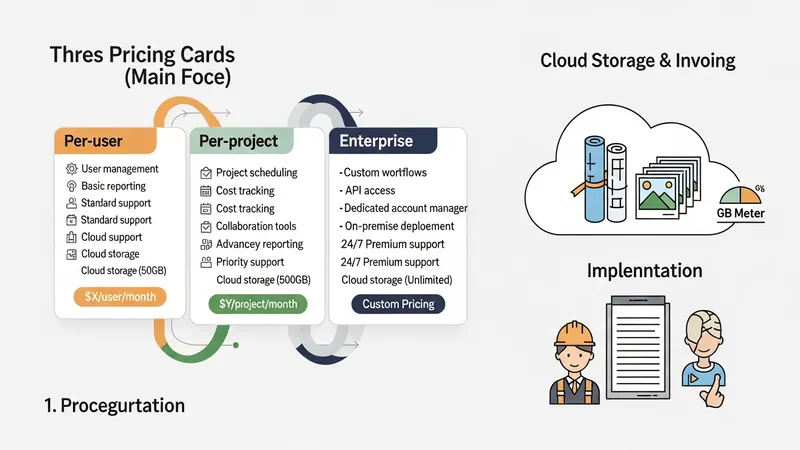
Typical cost considerations include user licensing tiers, storage usage, and premium modules for features like model coordination or advanced reporting. Per-user subscriptions in U.S. offerings may range widely depending on the vendor and level of functionality; procurement teams often request a breakdown of included services and any additional fees for third-party integrations. Total cost of ownership assessments commonly factor in internal change management and the time required for staff to adopt new workflows.
Implementation timelines and resource commitments are part of deployment planning. Platform rollouts may follow a phased approach—pilot projects first, then broader deployment—so that teams can refine configurations for U.S. contract and compliance requirements. Training for office and field personnel, and documentation of governance policies (naming conventions, versioning rules), are recurring cost drivers that organizations include when budgeting for a new system.
When comparing options, organizations often request vendor references from comparable United States contractors and examine sample contracts for data ownership and exit provisions. Attention to contract terms that define data export rights, retention periods, and support SLAs can reduce future operational risk. These procurement details are typically evaluated alongside functional fit and estimated recurring costs to form a comprehensive deployment decision.
Risk and compliance needs influence how construction teams manage digital project records. United States contractors may face requirements for document retention tied to lien statutes, permit records, or federal contracting provisions when applicable. Platforms that provide robust audit trails, tamper-evident records, and exportable archives can assist teams in assembling compliance packages for regulators, owners, or legal reviews. Project document governance often specifies retention schedules and access controls to align with contract terms.
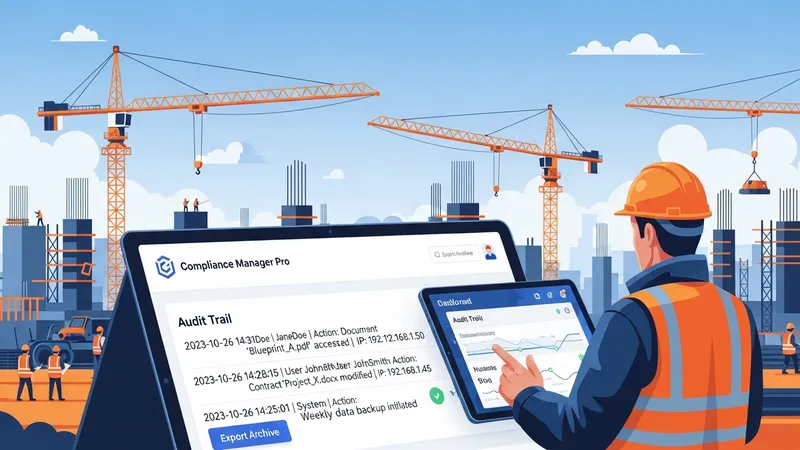
Security considerations commonly include authentication controls, encryption of data at rest and in transit, and vendor practices for backups and incident response. Construction organizations in the United States often require contractual assurances about data handling and may seek information about where data centers are located to assess jurisdictional considerations. Payment processing and payroll integrations also raise compliance points such as PCI requirements and payroll tax reporting accuracy.
Operational risk management addresses availability and continuity for field operations where connectivity may be intermittent. Offline capture and synchronization strategies can reduce data loss risk at remote sites. Additionally, role-based permissions and separation of duties are practical controls that limit exposure of financial or human-resources information while enabling project staff to access necessary construction records for daily execution.
Contract clauses and service agreements commonly define responsibilities for data access, export, and termination handling. United States contractors often review these terms to confirm that historical project data remains accessible after subscription changes and to ensure that dispute-resolution mechanisms are clear. Evaluating these legal and technical aspects alongside functional needs can support more resilient project delivery practices.